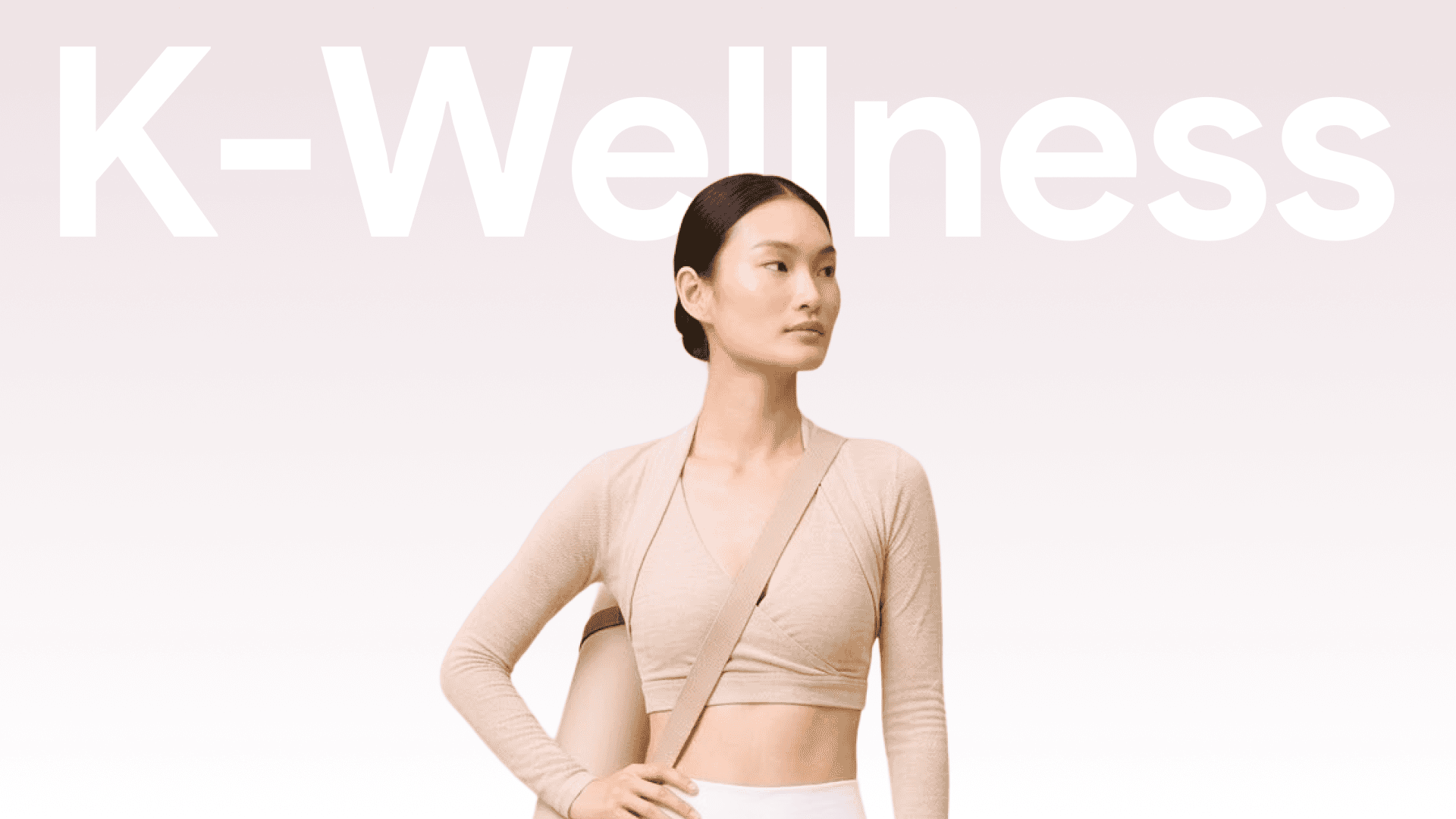
The Future's Brand Strategy Team has been sitting with one question.
If K-Beauty changed the world's bathrooms, and K-Food changed the world's tables — what gets changed next?
In searching for that answer, we weren't looking for a new trend. It was actually the opposite. Something that had long been woven into everyday life in Korea, but hadn't yet been gathered under a single name. That's the category we're calling K-Wellness. And the Future's brand strategy starts with a single ambition: to be the first to define it, and define it convincingly.
"When you look closely at what's right beside you, it ends up reaching further."
Shortly after the 2020 Academy Awards, Bong Joon-ho said something like this — that Parasite, a film filled with things that were purely, specifically Korean, had resonated across so many different countries. That perhaps looking most closely at what's nearest to you is exactly what allows you to move the whole world.
This isn't a story about film. It's closer to a principle.
K-Beauty, K-Food, K-Drama all spread across the world in precisely the same way. None of them were designed for a global audience. They were faithful representations of Korean daily life — and the world responded. And now, all three of those currents are pointing in the same direction.
The Brand Strategy Team's decision to place this momentum at the center of the Future's strategy comes from the same instinct. When we built Love Yourself as our philosophy, and designed the wellness journey across four categories — Nourish, Support, Enhance, Renew — part of that was a deliberate strategic move: to own the language of K-Wellness at the very moment the category is being formed.
What K-Beauty Taught Us: Skin Is Something You Tend, Not Something You Fix
Western skincare was largely built around elimination — targeting problems and removing them. Korea took a different view. If you build a healthy skin barrier to begin with, fewer problems arise in the first place. As that philosophy traveled the world, it redefined routine itself as a K-Beauty concept. K-Beauty didn't sell products. It sold a daily practice.
What K-Food Taught Us: The Table Is the Prescription
Kimchi, doenjang, makgeolli. The Korean table is built on thousands of years of fermentation culture. As research on gut health and immunity accumulated,² Korean food culture began to be introduced to the world not just through the language of taste, but through the language of function. None of it was scientifically engineered from scratch — it was the accumulated result of a body finding, over a very long time, what it actually needed.
What K-Drama Taught Us: Care Is Not a Genre — It's an Attitude
The protagonist of My Mister was exhausted. But she didn't let herself collapse. The lead in Little Forest left the city, cooked with what the season offered, and lived at the pace of the natural world. It's no coincidence that international viewers took something more than emotion away from those scenes. K-Drama has continuously translated the question how do I take care of myself? into scenes of beautiful, unhurried daily life. Audiences watched with subtitles, but they absorbed the lifestyle embedded within — eating in rhythm with the seasons, tending to relationships with care, refusing to put yourself last. K-Wellness is the next step: where that sensibility converts into actual consumption and daily routine.
Where the Three Currents Converge: K-Wellness
Back to Bong Joon-ho: "When you look closely at what's right beside you, it ends up reaching further." K-Beauty, K-Food, K-Drama are all products of that same principle. The most ordinary things — washing your face, sitting down to eat, feeling the shift in seasons — when met with the particular Korean sensibility for attentiveness and continuity, become something the rest of the world wants to learn.
This is why the Brand Strategy Team is treating K-Wellness not as a trend keyword, but as a structural pillar of brand strategy. At the point where these three currents converge, the Future is positioned to speak that language more credibly than anyone else. Seven countries, twelve-plus brands, and an integrated wellness journey across Nourish, Support, Enhance, and Renew — that architecture maps precisely onto what the K-Wellness category demands.
And K-Wellness isn't a marketing term for the same reason it isn't an ambitious goal. It's the small, daily commitment to not turning away from yourself. The Future's placement of Love Yourself at the center of our philosophy comes from the same place. A morning routine. A choice at the table. The sensitivity to read what a season asks of you. All of those small decisions accumulate, and quietly shift the direction of your body, your skin, your inner state. Not putting off self-care — that is the essence of K-Wellness, and the shape of everyday life the Future is trying to build.
References
Britz, G.W. et al. (2019). "Epidermal growth factor signaling in skin aging." Journal of Dermatological Science, 94(1), 2–8.
Kim, B. et al. (2021). "Fermented food consumption and gut microbiota diversity." Journal of Nutritional Biochemistry, 89, 108567.
Levine, B. & Kroemer, G. (2019). "Biological Functions of Autophagy Genes: A Disease Perspective." Cell, 176(1-2), 11–42.