In our last piece, we wrote about Love Yourself — the philosophical starting point behind everything the Future builds. Today is about what comes after the philosophy: the structural decisions, the design logic, and the harder question of how a belief system actually gets built into a brand architecture.
Four Categories That Connect the Contexts of Everyday Life
Every design problem begins with an honest look at how people actually live.
Some days you need something light and low-friction. Other days demand precision — the right nutrients, the right input, carefully considered. There are seasons of life when you turn inward and want to restore what's already yours, and there are moments when nothing works except breaking the old pattern entirely and starting fresh.
Life is that textured. That non-linear. So when we sat down to map it, the question wasn't what products do we want to build? It was: what does a person actually need, and when?
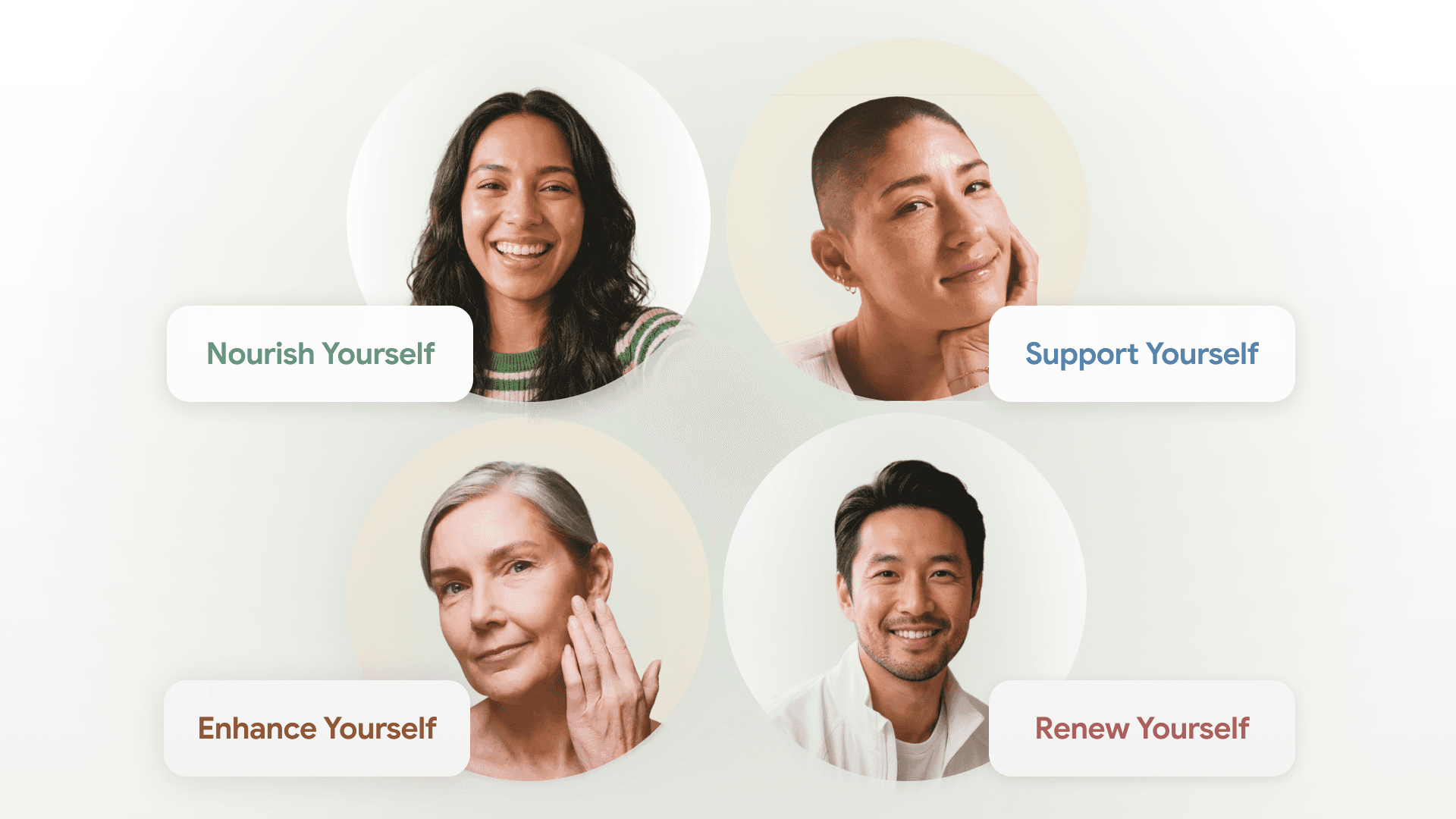
That's where the real design work began. Rather than forcing a single brand to stretch across every context — and losing specificity in the process — we structured wellness into four distinct, intuitive categories. Each one corresponding to a real moment in a real life.
Nourish yourself — Functional foods and inner beauty drinks that balance taste with nutrition (delinosh, nothingbetter, and more). Designed for daily life, with no barrier to entry.
Support yourself — Science-backed supplements built to hold the balance steady when daily life starts to erode it (dr.blet, tetracure, and more).
Enhance yourself — Anti-aging and cell care that surfaces what is intrinsically yours (eoa, cellboot, and more). Not about transformation — about revealing.
Renew yourself — Body performance tools, wearables, and physical spaces that help you dismantle a stagnant routine and rebuild it from the ground up (calo, remove, caloriebar, and more).
Brand Perspective: One Philosophy, Many Faces
There's a question that comes up every time you expand a brand portfolio: doesn't more mean murkier?
From a brand design standpoint, we'd argue the opposite is true — and it changes how you approach the work entirely. When a single brand has to speak to everyone, it inevitably starts to say nothing in particular. But when you give each brand a precisely bounded space to operate in, the identity work becomes sharper. More focused. More honest.
The architecture we built for the Future runs on a clear separation between the Master Brand and each Sub Brand. The Future holds the value layer — the Love Yourself philosophy that everything else is grounded in. Each sub brand sits beneath that canopy, but operates with its own distinct visual world, tone of voice, and target audience. A customer moving through delinosh is having a completely different brand experience than one moving through eoa. Different aesthetic, different emotional register, different conversation — but the same underlying sensibility running through all of it.
This matters for a reason we think about a lot in brand design: Trust Transfer. When someone has a genuinely good experience with one sub brand, that trust doesn't stay contained. It migrates. It creates openness to the next brand in the ecosystem. The individual fan becomes an ecosystem fan. That's not something you can manufacture through messaging — it's something you have to build into the structure.
Each sub brand is also designed with the goal of becoming a Category Leader — not a generalist trying to cover the widest possible ground, but a specialist with something specific and irreplaceable to say to a specific person. That's a harder design brief. But it's the only kind that creates lasting resonance.
Content Perspective: Speaking Four Languages
If each brand has its own face, it follows that each one needs its own voice. In the Future's content strategy, the four categories aren't a filing system for products — they're four distinct communication grammars. And designing those grammars is as deliberate a process as designing the visual identity.
Nourish content is light, sensory, immediate. It moves at the rhythm of daily life — a meal, a drink, a small habit shift. The design principle here is frictionlessness. Content should feel easy to consume, easy to act on, and natural in its transition toward product. Nothing heavy. Nothing that asks too much.
Support content is built around credibility. Ingredient sourcing, clinical backing, expert perspective. The challenge — and this is a genuinely interesting design problem — is building something that leads with information without feeling clinical or cold. The goal is the moment when a customer thinks: this brand actually knows what it's talking about, and it's talking directly to me. Once that trust lands, the relationship is already in motion.
Enhance content operates on a different register entirely. It's philosophical. It's about a person's relationship with time — not fighting it, not hiding from it, but learning to own it. Before we ever introduce a product, the content has to resonate with something interior. That's a softer kind of brand-building, but often the most durable.
Renew content is the opposite energy — kinetic, motivational, action-oriented. It's designed to move people. Video over text. Experience over explanation. High contrast, high momentum. The content in this category isn't trying to be contemplated — it's trying to be felt.
Taken together, the Future's content works as one value, four dialects. All of it ultimately says Love Yourself, but each dialect is calibrated to the customer who needs to hear it — in the form, tone, and frequency that actually reaches them. That translation work is ongoing, and it compounds. Done well, it's what moves a wellness company from selling products to genuinely inhabiting people's lives.
How the Four Categories Create Synergy
One of the more satisfying things about a well-designed multi-brand architecture is watching the ecosystem work the way it was intended to.
No brand competes with another. Each one occupies its own territory and solves for its own customer problem. But the borders are permeable by design — because customers don't live in categories. A customer who first encounters the Future through a supplement (Support) and starts to feel real change in their body will naturally begin looking for what comes next. Maybe that's a body care studio (Renew). Maybe it's rethinking what they eat (Nourish). The four categories are designed to turn together, creating a continuous experience that can — in theory — accompany someone across a lifetime of caring for themselves.
That's the goal. Not a brand you buy from once, but a system you live inside.
A Universal Language Across Borders
The desire to take care of yourself doesn't need translation. But how that desire shows up — what it looks like, what it feels like, what it reaches for — is shaped entirely by local context.
The four-category framework was also designed with this in mind. It's a flexible architecture. In markets where inner beauty is the dominant entry point, Nourish leads. In markets shaped by K-beauty culture, Enhance brands move to the front. The framework doesn't change — the configuration does. And the same principle applies to content: localization isn't just language conversion. It's a full reinterpretation through the lens of how people in that market actually live and what genuinely resonates with them. The four categories give us the structure to do that without losing coherence across the whole.
In Closing
Good brand design isn't just about how things look. It's about how systems hold together — how a philosophy becomes a structure, how a structure enables experiences, and how those experiences accumulate into something that actually means something to the people inside it.
The four-category, multi-brand architecture of the Future is that kind of design work. Each brand has its own sharp identity. Each speaks in its own voice. And each individual experience is built to connect back into the larger whole.
We hope that within this ecosystem — intuitive in structure, diverse in expression — you find the version of wellness that fits exactly who you are.